Agent Chat
A resumable agent session provider and chat board for the installed Claude and Codex CLIs.
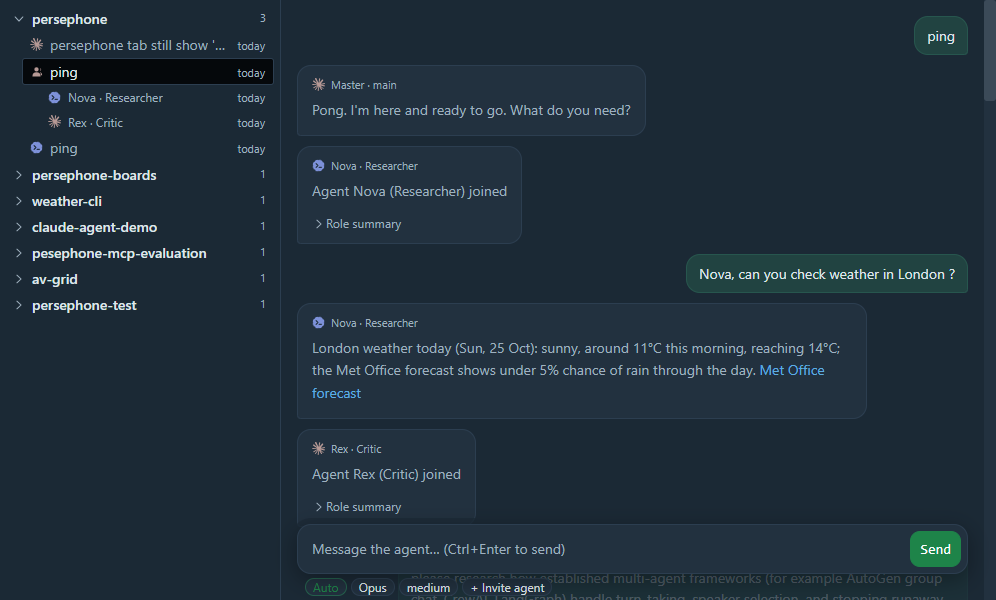
An agent that lives inside Persephone
Agent Chat is a chat page for the Claude Code and Codex command line applications you already have installed. Each one signs in with your own account, and the board never touches your credentials. Choose the engine, model and effort for each new chat. Sessions from both engines share one sidebar, grouped by working folder.
- Knows Persephone from the start. The board ships instructions that tell the agent it is working inside Persephone. Before it asks you to paste anything, it reads the pages you have open: the active page, the page beside it, a screenshot you pasted. You can edit these instructions for each engine.
- Works with Persephone without any setup. Each chat gets its own private Persephone MCP endpoint, so the agent can read and drive your pages, the browser and boards even when Persephone's MCP server setting is off. The endpoint is revoked when the session ends.
- Group chats. Invite more agents into a conversation: a reviewer, a critic, a researcher, a developer, or a profile of your own. Claude and Codex agents can work in the same chat. Each agent keeps its own session and model and sees the shared timeline. Every post carries its author's badge, and the main agent moderates.
- The terminal's features in a chat page.
- Auto, Plan and Bypass permission modes, with approval cards
- slash commands, plus
/mcpand/contextpanels - subagent transcripts, and several sessions running side by side
- usage limits and cost
- it can follow and resume sessions you started in a terminal
- Voice input. With the Speech to Text board installed, the microphone button dictates into the message box.
Agent Chat also provides the agent.session service, so other boards can open agent sessions through it.
| Version | 1.4.2 |
|---|---|
| Needs Persephone | 5.0.18 or later |
| Download size | 318 KB |
Install
Install Agent Chat from Persephone's Published Boards catalog. The board is downloaded, checked against its published checksum, and runs only after you trust it.